



Handwriting, Identity, and a Forgotten Umbrella from AIT
How a Taiwanese handwriting artist unexpectedly became part of an international diplomatic moment
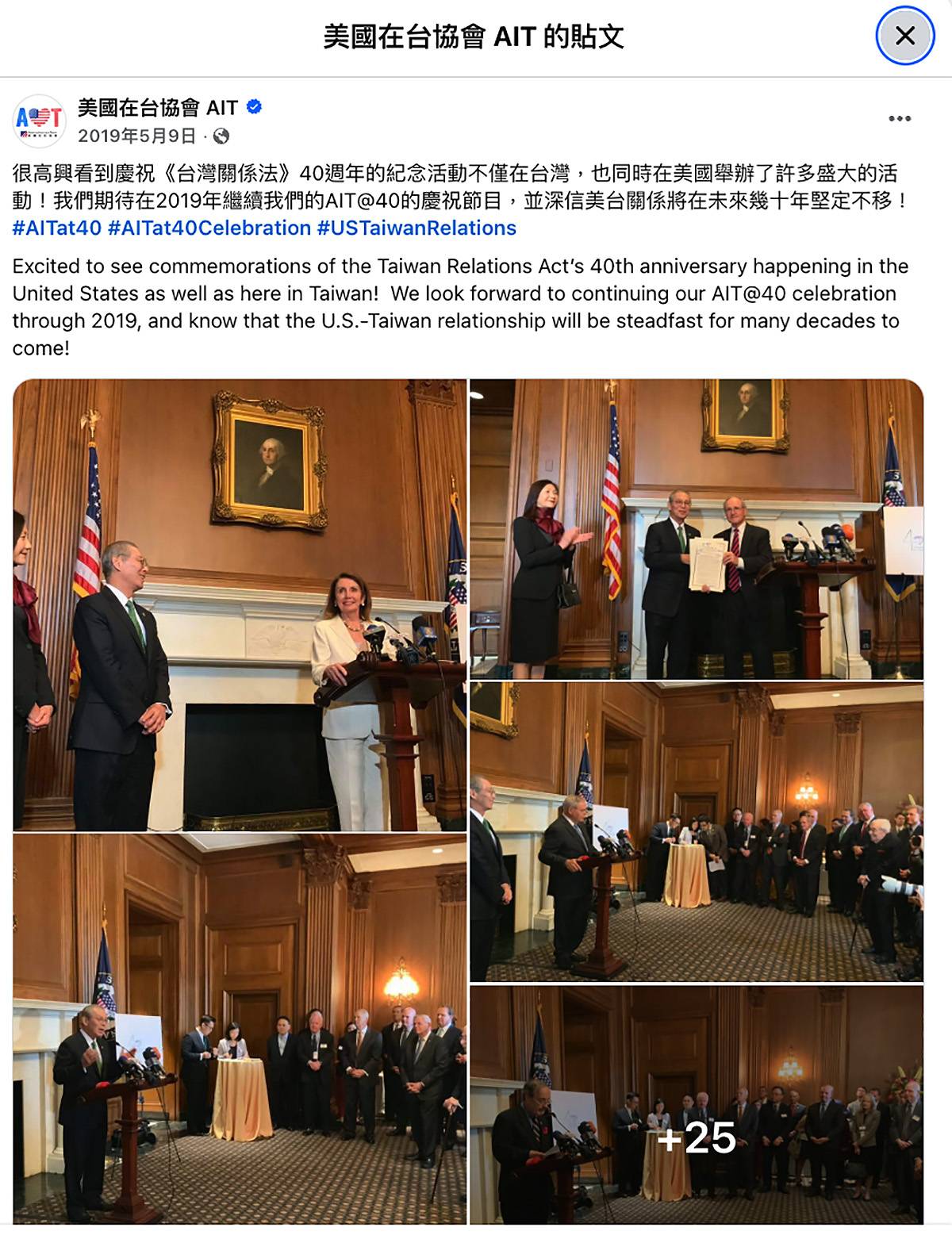
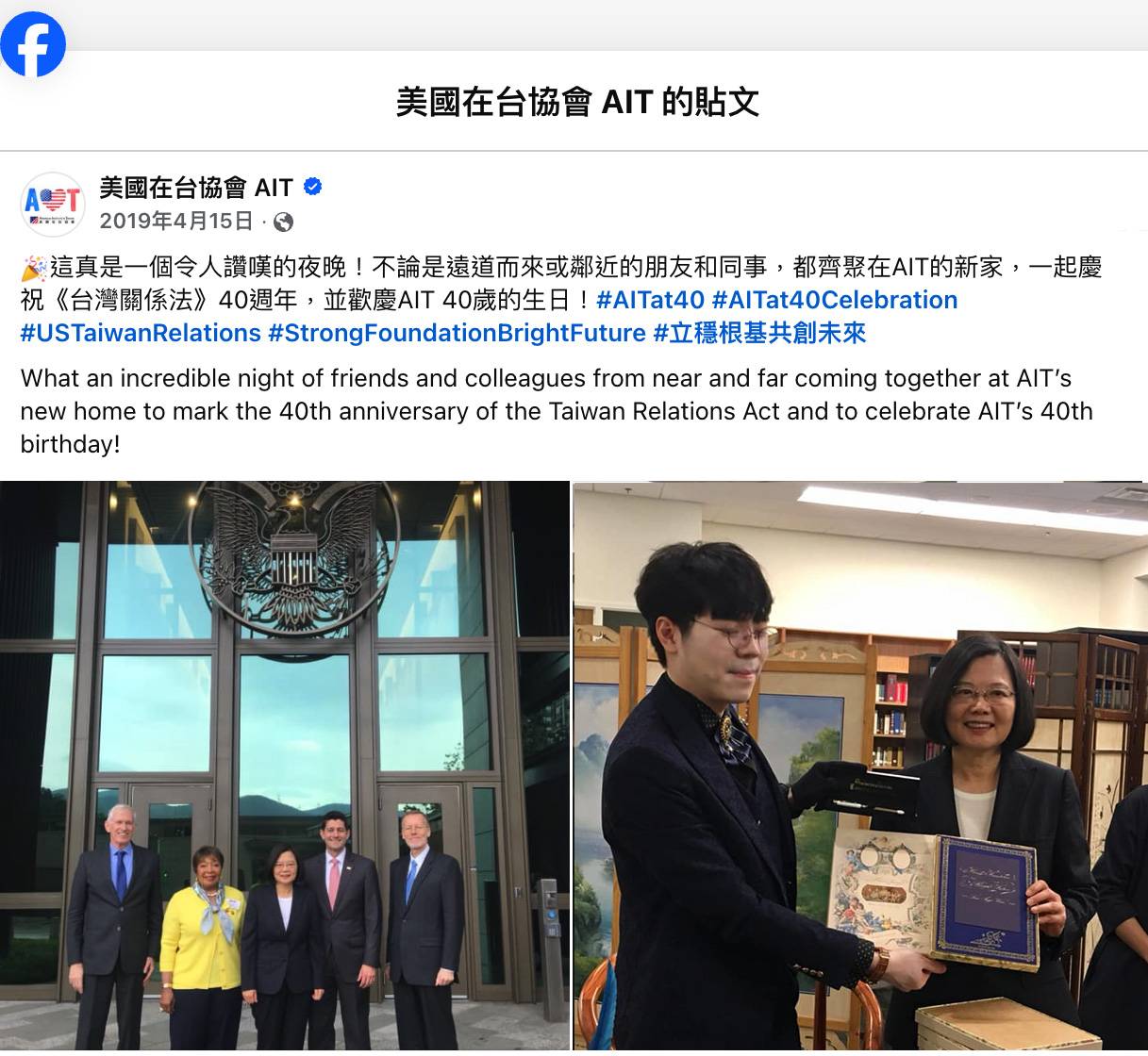
In 2019, I was invited by the American Institute in Taiwan (AIT) to participate in the 40th anniversary celebration of the Taiwan Relations Act (TRA40).
Looking back now, I realize that I did not fully understand the significance of that invitation at the time.
In fact, I almost declined it.
My teaching schedule was already full, and I have always preferred a quiet life, far removed from politics, publicity, or public attention. My wife and I even discussed whether it might be better to recommend someone else instead.
At the time, there were many English calligraphy artists who were far more visible than I was. They had larger audiences, published books, television appearances, and growing social media followings.
By comparison, I was living in a rather different world.
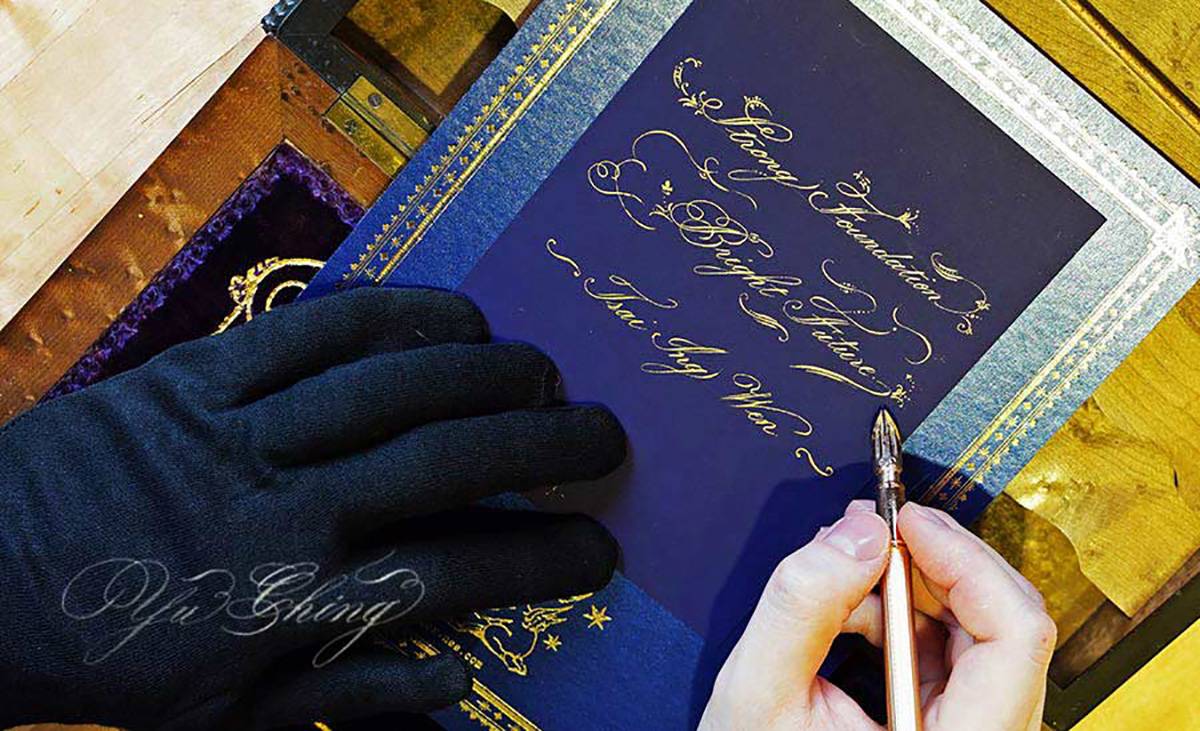
My days were spent among fountain pens, antique books, handwritten lettering, sealing wax, classical calligraphy, and the study of signatures. I was less interested in becoming well-known than in understanding why handwriting still mattered in a rapidly changing world.
That was the life I knew.
And because of that, I never imagined that a single invitation would eventually become one of the most meaningful chapters of my professional journey.
Years later, when I look back at the photographs, the conversations, the long lines of guests waiting with their names in hand, and the unexpected opportunity to design signatures for diplomats, government officials, and international guests, I understand something I could not see then.
The invitation was never simply about writing names.
It was about identity.
It was about the enduring human desire to be recognized, remembered, and represented through something as personal as a signature.
At the time, I could not fully appreciate the significance of that moment.
Today, I see it differently.
What seemed like an ordinary event became a reminder that handwriting is not merely a skill. It is one of the ways people leave their presence in the world.
AIT Did Not Ask Me to “Perform”
Years later, after rediscovering old emails, photographs, and official records, I slowly came to understand something I had completely missed at the time.
AIT was not simply looking for someone with beautiful handwriting.
They were looking for someone who could represent a particular cultural atmosphere — someone whose work reflected the human side of handwriting, identity, and personal expression.
Back then, the instructions I received were surprisingly simple.
The AIT team told me only one thing:
“President Tsai will be attending. We would like you to prepare a handwritten piece and design her English signature.”
That was all.
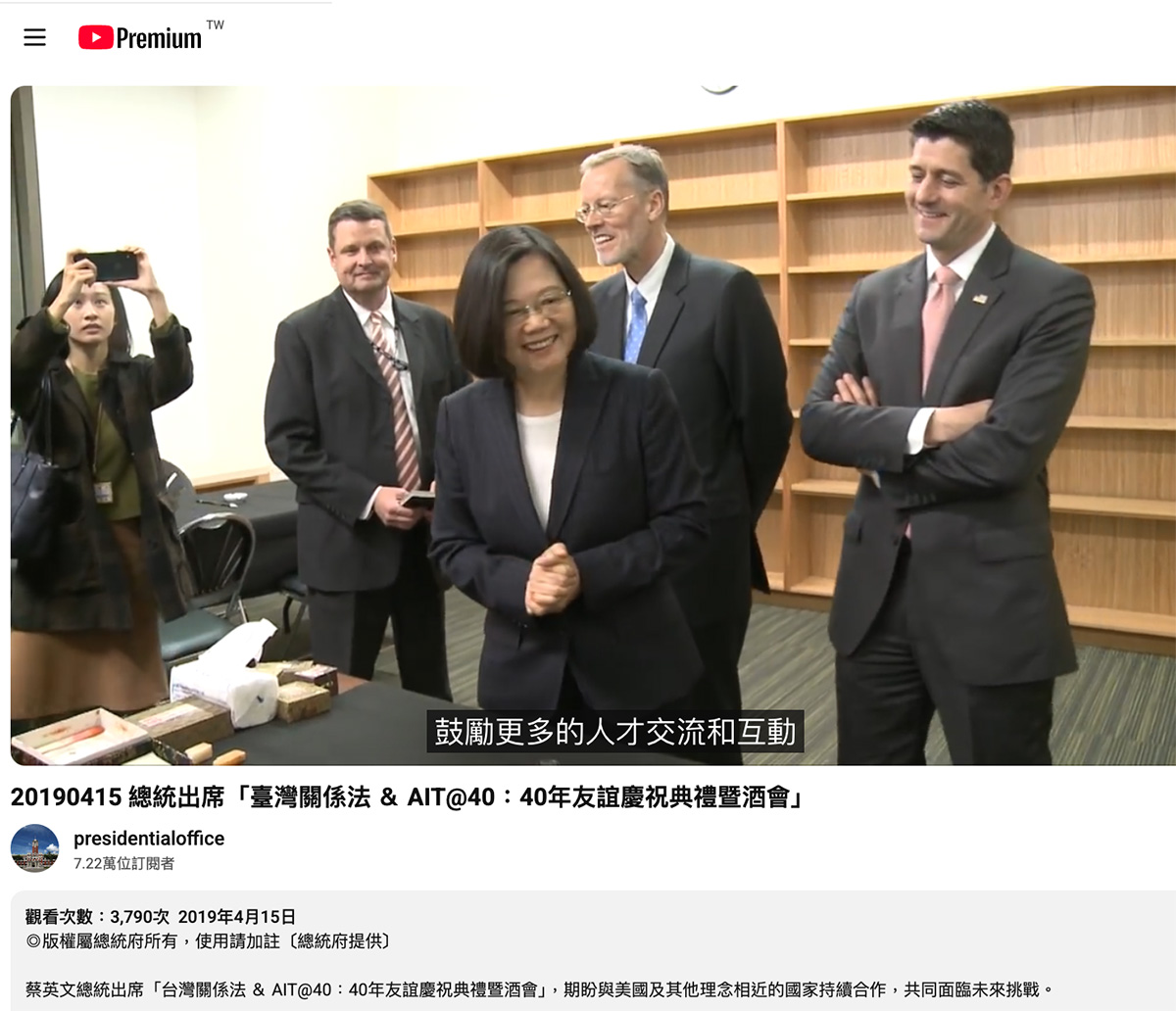
No one explained the historical significance of the event. No one mentioned that senior American and Taiwanese officials would be present. No one told me that people such as Paul Ryan, James F. Moriarty, and Brent Christensen would be standing only a few steps away.
To be completely honest, I did not even know who many of them were.
At that moment, none of those names carried any particular meaning for me.
My attention was elsewhere.
I was thinking about paper, ink, handwriting, and the responsibility of writing each person’s name correctly.
I worried about spacing, rhythm, proportions, and whether each signature would feel natural to the person receiving it. I spent my time preparing pens, testing ink flow, and thinking about how a handwritten name might become part of someone’s personal identity.
Looking back now, I find that perspective almost amusing.
Around me stood diplomats, government officials, and international guests. Yet my entire world had narrowed to a simple question:
How can I honor this person’s name?
Perhaps that was exactly why AIT invited me in the first place.
Not because I was the most famous artist.
Not because I had the largest audience.
But because I genuinely believed that a name mattered.
Even today, after years of teaching, designing signatures, and studying personal identity through handwriting, I still believe the same thing.
A signature is never just a signature.
It is one of the smallest and most personal ways a human being says:
“This is who I am.”
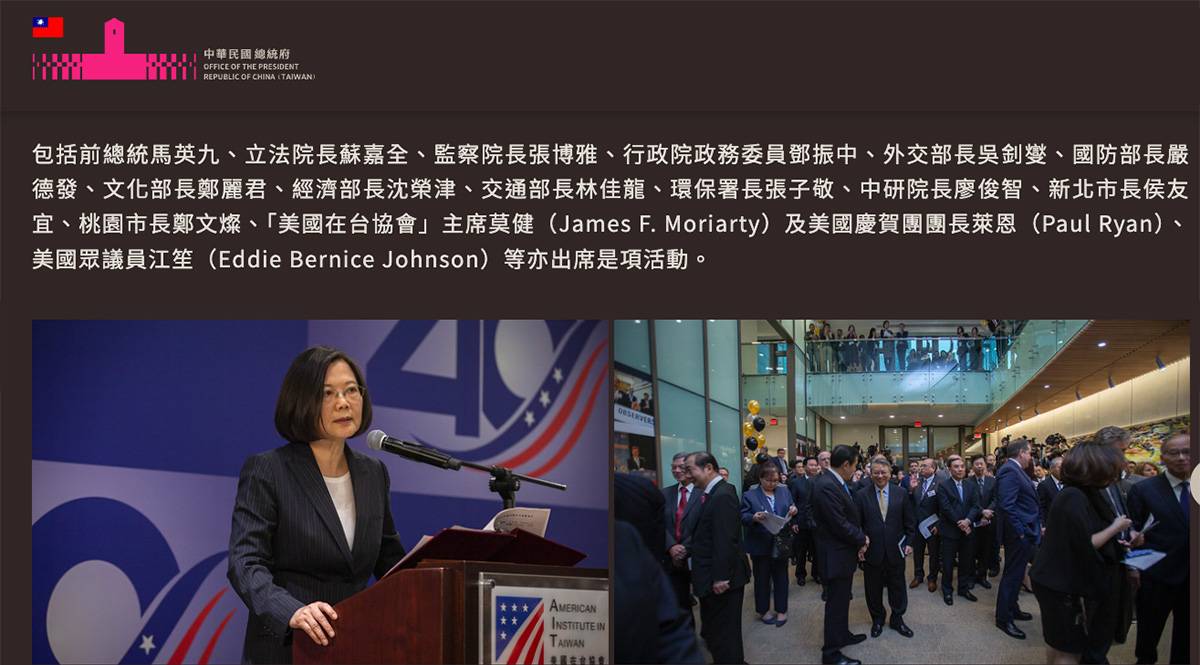
Images sourced from the official website of the Presidential Office, Republic of China (Taiwan)
The Moment Everything Suddenly Changed
Originally, I prepared only a limited number of pieces.
In my mind, this was a formal commemorative event. I expected to create a handwritten work for President Tsai and perhaps a small number of additional guests. Nothing more.
At least, that was the plan.
But once the event began, everything changed.
As diplomats, government officials, media representatives, and international guests arrived, word started to travel quietly across the venue.
“There is an artist here designing handwritten English signatures.”
Within a surprisingly short time, a line began to form in front of my table.
Then the line became longer.
And longer.
People approached one after another, handing me business cards, introducing themselves, and asking whether I could design a signature for them as well. Some waited patiently. Others returned later with friends and colleagues.
Very quickly, what had been planned as a small part of the event became something entirely different.
The atmosphere shifted.
I barely had time to look at each card before moving on to the next name.
Around me, conversations continued, speeches were delivered, photographs were taken, and officials moved through the venue. Yet my world had narrowed to a continuous flow of names, faces, and signatures.
Even the AIT staff seemed surprised by what was happening.
None of us had expected the response.
We were improvising in real time.
Looking back now, I realize how fortunate I was to have developed a habit through years of working with luxury brands, VIP events, and live calligraphy projects.
I always prepare more than I think I will need.
More paper.
More cards.
More ink.
More materials.
More backups.
At the time, it simply felt like professional caution.
That day, however, those extra preparations became essential.
Had I arrived with only the quantity originally planned, I would have run out almost immediately.
Years later, one of the AIT officers said something that stayed with me.
“Thankfully, we invited you.”
At the time, I smiled politely, but I did not fully understand what he meant.
Now, after revisiting the photographs, emails, and memories of that day, I think I finally do.
He was not talking about handwriting.
He was talking about preparation.
About experience.
About staying calm when a carefully planned event suddenly becomes something much larger than anyone expected.
And perhaps, without realizing it, that was exactly what my years of teaching, design work, and live events had prepared me for.
A Diplomatic Event Is Not Like a Movie
When people imagine an international diplomatic reception, they often picture elegant conversations, carefully choreographed photographs, and distinguished guests calmly moving through a beautifully arranged venue.
That may be how such events appear in official photographs.
The reality feels quite different.
Official events move quickly.
People arrive, schedules shift, unexpected situations emerge, and hundreds of small details unfold simultaneously. Behind every polished image is an enormous amount of coordination, preparation, and real-time decision-making.
The TRA40 celebration was no exception.
As more guests entered the venue, the atmosphere became increasingly busy. Conversations overlapped. Introductions happened constantly. Lines formed unexpectedly. Before long, everyone was fully occupied.
At one point, the pace became so intense that even something as simple as drinking water was forgotten.
Next to my table sat a nationally respected senior calligrapher and his wife.
The elderly couple stood for hours without rest, writing traditional Chinese calligraphy for guests one piece after another. Compared with them, I was fortunate. At least my English signature work allowed me to remain seated.
Yet none of us were paying much attention to comfort.
We barely spoke throughout the event.
Not because we were unfriendly, but because we were completely focused on the work in front of us.
Name after name.
Card after card.
Signature after signature.
Even when President Tsai approached our tables, there was little time to pause. We briefly looked up, acknowledged the moment, and then returned immediately to writing.
At the time, it felt entirely ordinary.
Only years later, when looking back through photographs and memories, did I begin to understand what was happening around us.
While many people remember diplomatic events through speeches, dignitaries, or official photographs, my strongest memory remains something much quieter.
The concentration.
The responsibility.
The simple act of trying to honor every person’s name with the same level of care.
Looking back now, I think that quiet focus may have been the most authentic part of the entire event.
Amid diplomacy, media attention, and historical symbolism, there were still people doing what they had spent their lives learning to do.
One person writing calligraphy.
Another designing signatures.
And for a few brief hours, that work became part of a much larger story.
“You Look Like You Came Out of Pride and Prejudice”
Among all the memories from the TRA40 celebration, there is one that still makes me smile whenever I think about it.
Throughout the event, international guests frequently stopped by my table and asked questions.
“Which country are you from?”
“Where did you learn these scripts?”
“Are those real antique writing instruments?”
“How old are you?”
Some seemed more curious about the tools than the signatures themselves.
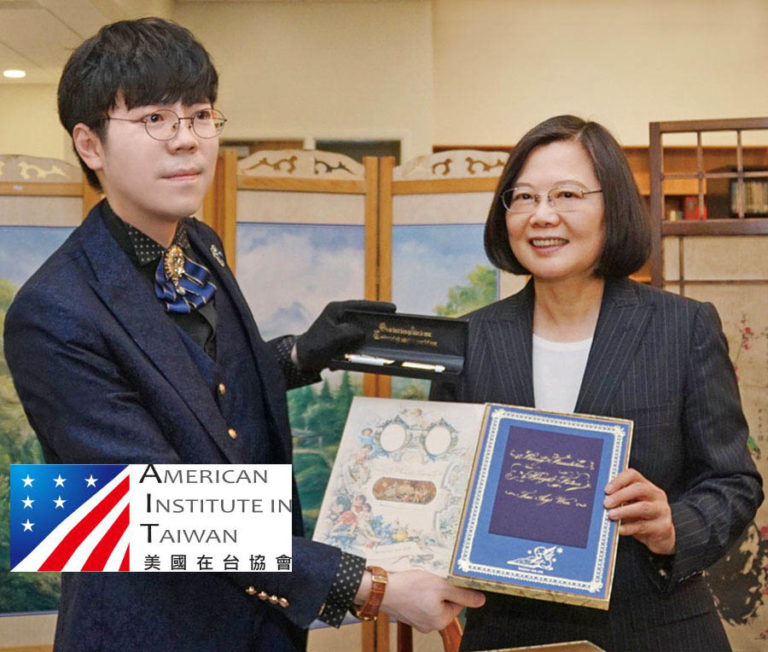
Even President Tsai initially assumed that I was one of the foreign guests attending the event.
Looking back, I can understand why.
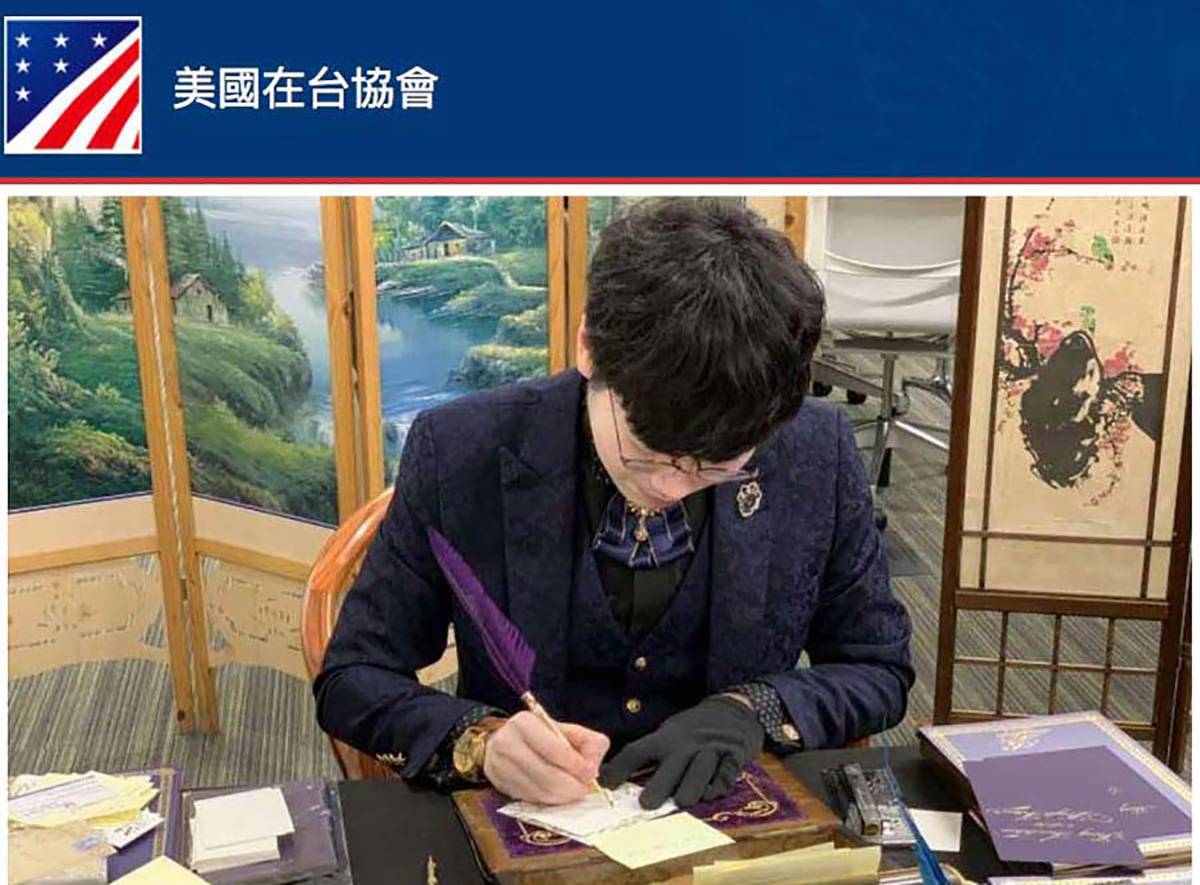
The table was covered with fountain pens, antique writing instruments, embossed cards, and handwritten samples. It probably looked quite different from everything else in the room.
One moment, however, has remained especially vivid in my memory.
During a group photograph, then-Minister of Economic Affairs Wang Mei-hua paused, looked at my writing tools and handwritten pieces, and said with a smile:
“Your handwriting and tools feel like something from Pride and Prejudice.”
She explained that the fountain pens, classical scripts, ribbon tie, and antique writing instruments reminded her of a nineteenth-century European world.
I laughed and replied honestly:
“This is simply how I normally dress and work.”
Her expression immediately changed.
Not because she doubted me, but because she seemed genuinely surprised.
What many people did not realize that day was that none of it had been specially prepared for the event.
The deep blue suit.
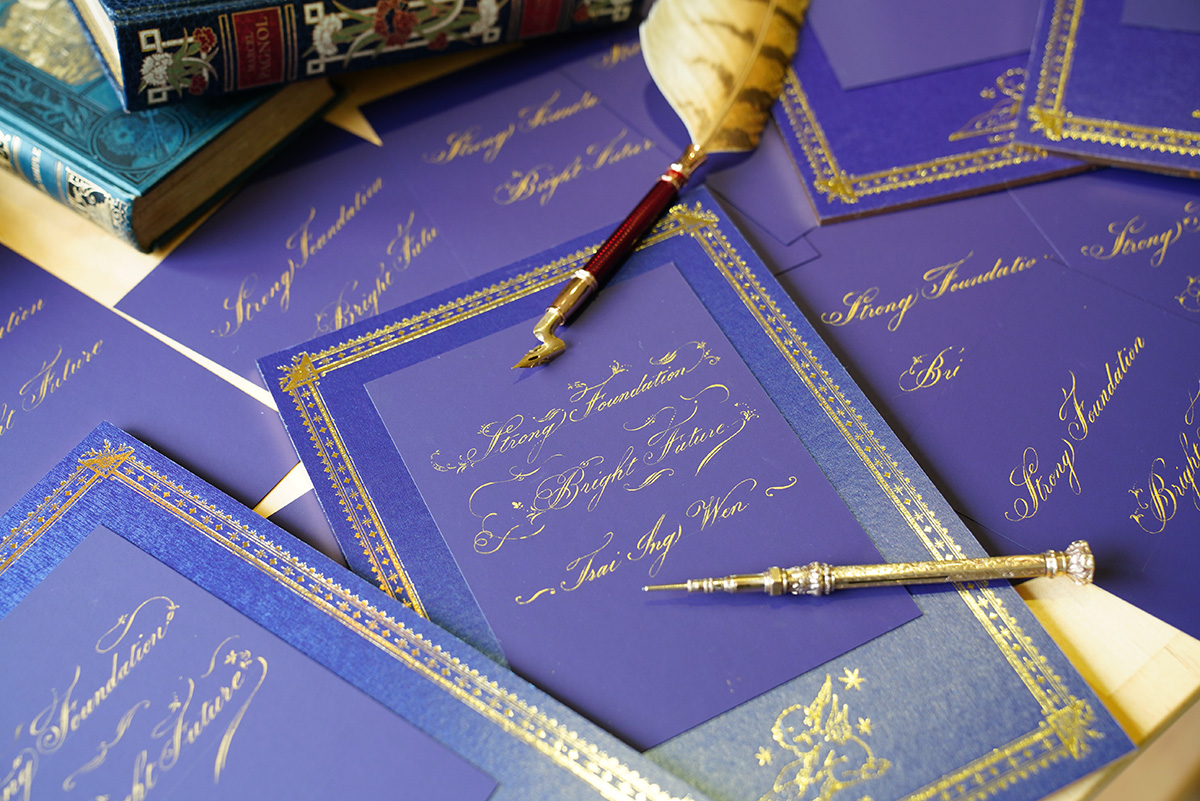
The violet feather pen.
The gold-embossed cards.
The antique writing case.
They were not props.
They were not part of a performance.
They were simply pieces of a life I had already been living for many years.
Long before AIT ever contacted me, I had spent countless hours studying historical scripts, collecting antique writing instruments, visiting old bookshops in Europe, and exploring the relationship between handwriting, identity, and culture.
The event merely revealed that world to a larger audience.
Looking back now, I think that moment taught me something important.
People often assume that authenticity comes from trying to appear unique.
In reality, authenticity usually comes from spending years quietly becoming yourself.
And perhaps that was what people were responding to that day.
Not the pens.
Not the clothing.
Not even the signatures.
But the feeling that everything on that table belonged to the same story.
Years Later, I Finally Noticed the Colors
Only recently, while reorganizing old photographs from the TRA40 event, I noticed something I had completely overlooked at the time.
It was not a person.
Not a speech.
Not even one of the signatures.
It was the colors.
As I looked more carefully at the photographs, I realized that the entire visual atmosphere surrounding my table seemed to blend naturally with the official branding of the AIT 40th Anniversary celebration.
Deep blue.
Violet-blue tones.
Touches of gold.
A quiet sense of classical elegance.
The fountain pens, handwritten cards, ribbon tie, antique writing case, and even the paper itself all appeared strangely harmonious with the official TRA40 visual identity.
The more I looked, the more surprised I became.
Because none of it had been planned.
AIT never provided a dress code.
No one suggested specific colors.
No one asked me to coordinate my materials with the event branding.
In fact, I had simply brought the things I normally used.
The pens I loved.
The papers I preferred.
The colors that had surrounded my work for years.
At first, I thought it was merely a coincidence.
But the longer I sat with the photographs, the more emotional the realization became.
For years, I had quietly built a world around handwriting, fountain pens, antique books, personal identity, and European writing culture.
It was never created for a diplomatic event.
It was never designed for a public audience.
It was simply the life my wife and I had chosen to live.
Yet somehow, when the invitation from AIT arrived, that world already felt at home there.
Looking back now, I think that may be one of the most meaningful lessons hidden inside the story.
The most important opportunities in life rarely come from changing who we are in order to fit a moment.
More often, they arrive when years of quiet dedication have already shaped us into the person that moment requires.
I did not prepare myself to match the event.
Instead, I discovered that the world I had been building all along already belonged there.
The Forgotten Umbrella
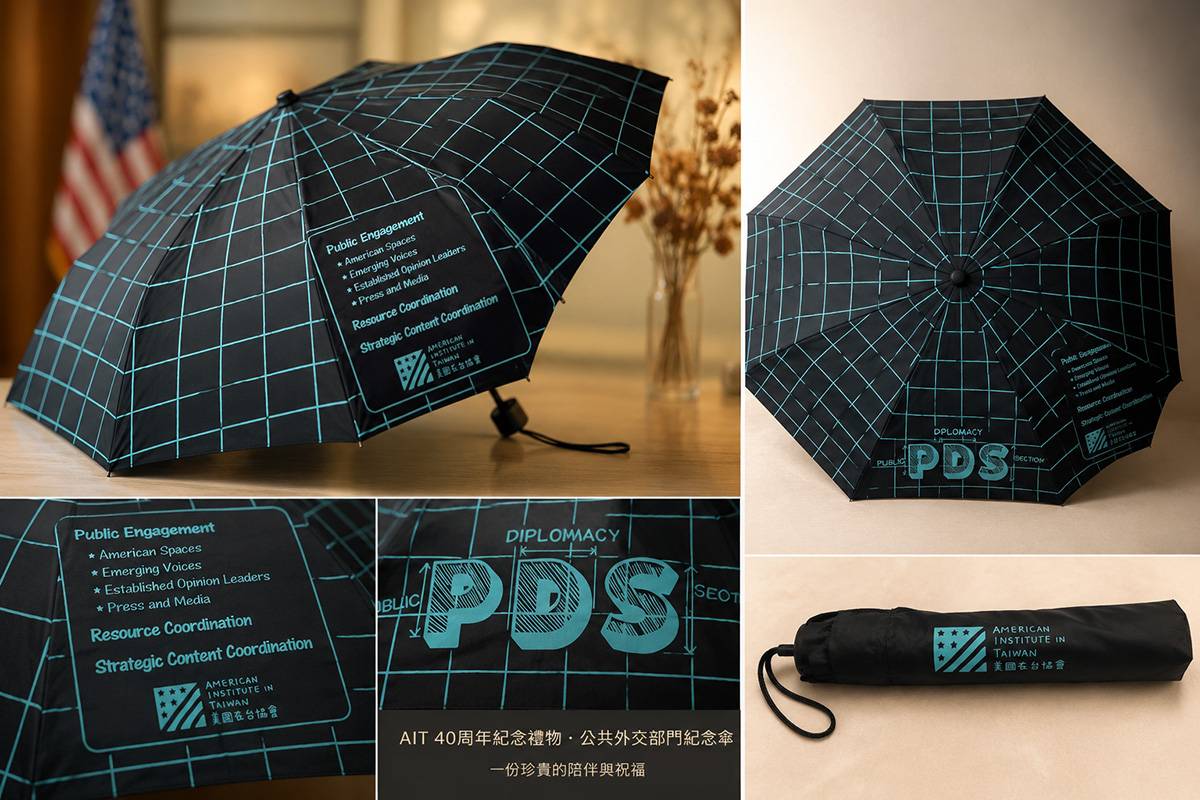
After the event, AIT gave me a commemorative umbrella.
To be honest, I did not think much about it.
When we returned home, my wife looked at it, laughed, and said:
“This umbrella is kind of ugly.”
I laughed too.
So the umbrella was placed in our shoe cabinet and quietly disappeared into everyday life.
For years, I never opened it.
I never used it.
And eventually, I almost forgot it existed.
Then, seven years later, while sorting through old photographs and documents for this article, I came across it again.
Out of curiosity, I opened it for the first time.
What happened next surprised me.
Printed on the umbrella were words I had never noticed before:
“Public Diplomacy Section.”
Beneath it were several phrases:
- Public Engagement
- Emerging Voices
- Established Opinion Leaders
- Press and Media
I stood there staring at the umbrella for a long moment.
Suddenly, it no longer felt like an ordinary souvenir.
It felt like a message I had received years ago but had only just learned how to read.
Back in 2019, I paid little attention to titles, departments, or organizational structures.
I was focused on handwriting.
On names.
On signatures.
On doing my work well.
I never stopped to consider which division had invited me, why they had invited me, or what role they believed I might play within the event.
But seven years later, those words carried a very different weight.
The Public Diplomacy Section was not responsible for protocol or logistics alone.
Its work centered on cultural exchange, public engagement, media relations, and communication between people from different backgrounds and societies.
And suddenly, a question appeared in my mind.
Perhaps AIT had not invited me simply because I could write beautifully.
Perhaps they saw something larger.
Not a calligrapher.
Not a performer.
But someone whose work connected handwriting, culture, identity, and human interaction.
Someone who could help create conversations through something as simple as a name.
Standing there with that umbrella in my hands, I felt an unexpected sense of gratitude.
Because sometimes life leaves clues long before we understand them.
And sometimes, it takes seven years before a forgotten object reveals the meaning it carried all along.
From Fuzzy Memories to an Official Historical Record
When I first began writing about the TRA40 experience, I hesitated.
Not because the event was unimportant, but because so much time had passed.
Seven years is a long time.
Memories become fragmented. Details blur together. Certain moments remain vivid, while others slowly fade into the background.
To be honest, I even worried that people might think I was exaggerating the story.
Sometimes I wondered whether I remembered everything correctly myself.
But as I started organizing old photographs, emails, and documents, something unexpected happened.
The internet remembered what I had forgotten.
One piece at a time, the story began to reassemble itself.
Official AIT records.
Presidential Office videos.
Yahoo News coverage.
Event posters.
Government photographs.
Archived media reports.
Each source revealed another small fragment of the same day.
What surprised me most was how precisely everything aligned.
In the Presidential Office footage, I could clearly see the blue-and-gold artwork prepared for the event. It perfectly matched the original handwritten pieces that had remained in my possession all these years.
The feather pen.
The embossed cards.
The antique writing case.
The diplomatic reception hall.
The guests.
The signatures.
The photographs.
Everything connected.
It felt less like researching history and more like rediscovering a forgotten chapter of my own life.
For years, I had treated the experience as a pleasant memory.
An unusual invitation.
An interesting day.
A story occasionally shared with students.
But as the evidence accumulated, I began to see it differently.
What I had experienced was not simply a calligraphy demonstration or a signature-design event.
It was part of a larger historical moment.
A gathering that brought together diplomacy, culture, media, education, and public exchange.
And somehow, through handwriting, I had become a small part of that story.
Perhaps the most surprising realization was this:
The event had never disappeared.
While my memories slowly became fuzzy, the historical record remained quietly intact.
Waiting.
Preserved in photographs, official archives, videos, and public documents.
And only years later, when I finally began looking again, did I realize that history had been remembering the story long after I had stopped thinking about it myself.